

The bittersweet journey of a newbie RHCE. Many people want to earn their RHCE certification — let me share how I became one.
1 Love at First Touch
I first encountered Linux in November 2003. Back then I thought it was quite mysterious, because I’d heard it was on the same level as Unix. I spent a month learning the basics. Only then did I realize that Linux and Unix are completely different on the inside yet strikingly similar on the outside — at least that’s what I thought, since I’d never actually used Unix at the time, haha. Back then, when studying network services, I was utterly confused and had no clue at all. I thought this stuff was incredibly difficult. But I was deeply drawn to the open-source spirit of Linux — the idea that everyone could learn together, advance together, and share technical resources. How fun would learning and working be then? So I didn’t give up, haha.
2 A New Level of Improvement
In early 2004, I took courses on CICSO (Cisco), which included TCP/IP and the principles of routing and switching. It was only then that I truly understood how those network protocols I couldn’t grasp before actually worked. Around this time, I also learned from a classmate about the RHCE professional certification exam. I joked with him: if I got this certification, I could definitely become a real blue-collar worker, then a white-collar one, and then enjoy a stable life — haha. I’m the kind of person who loves a leisurely, carefree life. My life goal is simply to travel around without worries. Though the goal isn’t lofty, I’ll give it my all.
3 Target: RHCE
Around April to May 2004, I started searching online for everything related to the exam. I didn’t let a single piece of relevant material slip by — I saved it all in a folder called RHCE and began digesting it bit by bit. By then, my classmates were gradually forgetting their Linux lessons, since they had only studied it for broader knowledge. I was practically alone — until later, when a student from another class started learning Linux in one of our labs as well. Only then did I have a study buddy. He was also a Linux enthusiast, but his passion lay in “how to make Linux more universally usable” — making Linux better or capable of replacing Windows for daily work. His learning materials were posts from online Linux enthusiasts, covering things like how to run Windows software on Linux, how to make KDE prettier, how to change mouse cursors, and similar things. He rarely studied the network services side, though we did do quite a few network service experiments together.
4 Learning to Let Go
In May 2004, my classmates started learning CCNP, taught in person by a CCIE. By then, most of the networking-focused students had already passed CCNA and were gearing up for the NP courses. I had also passed CCNA, but I needed to make a new choice. Path one: pause Linux, go all-in on CCNP — that would make finding a job much easier. That was the path most people chose. Path two: keep studying Linux and pass the RHCE exam by July. This route was more challenging. I knew the exam was tough — failing would be really troublesome. That included the 2,000-yuan exam fee from my family and possibly no more time to study again, since I wanted to start working by August. I gave up the CCNP courses and plunged into RHCE alone. This was my dream. I wanted to achieve it. I wanted recognition from others — and from myself.
5 Facing Reality
In July 2004, I got word that the multiple-choice section in the middle of the exam had been removed. I secretly rejoiced — my English wasn’t great, and misreading a multiple-choice question could have disastrous consequences. With that obstacle gone, I was ready to register. By then, my only study buddy had already landed a Linux-related job after a month of searching — as a Linux sysadmin and PHP programmer. I knew he had never studied PHP before; this was a real test for him. He bought relevant books and started cramming frantically. Two weeks later, he was fired. He simply couldn’t learn PHP in such a short time, and the sysadmin work was minimal — the environment was already set up and the management was dead simple. The company didn’t see the need for a dedicated admin for such a system. That classmate also told me: ‘90% or more of companies have no idea what RHCE is.’ Hearing that, I was stunned. My resolve began to waver. My mind was a mess.
6 Finding Another Path
In August 2004, after several days of deliberation, I decided to put off the RHCE exam for now. I figured that with solid expertise, I could surely find a suitable job. I also thought that beyond Linux itself, I should learn another strong skill. Programming wasn’t my thing — watching people around me go through the pain of learning to code was enough. CCNP required too much time, and I had already studied the routing protocols for NP anyway. That left databases. I wanted to learn how to install a few common databases, basic usage, configuration, backup, and restoration. PostgreSQL and MySQL took only a few days to get the hang of. The remaining one was Oracle. I chose Oracle 9i as my learning version and found installation guides online. What followed was three weeks of frustration — online resources were all over the place with conflicting advice, including official documentation. I fell into despair. I decided to just find an entry-level job first and learn the rest on the job. Low pay was fine — I’d treat it as an education. As long as someone would take me. So I registered on 51job and sent out my first-ever résumé.
7 A Spiritual Anchor
I sent out quite a few résumés, but given my skill level at the time, it was only natural they all sank without a trace. I began to reflect deeply. Had I really chosen the wrong path? Was breaking into this field truly that hard? My family and classmates gave me tremendous support. Everyone thought that if I gave up now, all my prior effort would likely go to waste. My parents said over the phone: ‘Son, if things aren’t working out, just keep studying until you can find a job.’ I made my final decision. I’d go all out. No matter how hard the exam was, no matter whether anyone even knew about it — pass first, then figure out the rest. Cast everything aside. Target: RHCE.
8 All or Nothing
In September 2004, I went to register for the exam. To save time and increase my chances of passing, I opted for training first, then the exam. Even though I felt I didn’t really need the training, it would at least let me understand every aspect of the certification exam. After 10 days of training, I felt I’d learned very little — it was really just a standardization of exam content. The training, however, recalibrated my study focus. I used to study things in depth, rarely memorizing surface-level details — I’d just look them up in a book when needed, since those things rarely come up in real work anyway. But through the training, I learned that the exam was the exact opposite — it tested exactly those broad yet shallow things. Knowing this, I began my review. A lot of it was rote memorization — commands and their parameters, all had to be recallable instantly. I wanted to take the exam in October, but the exam center staff, worried that rushing me might hurt their pass rate, didn’t notify me. They scheduled me for December 29. I only found out later that there had been an exam session in October.
9 Lady Luck
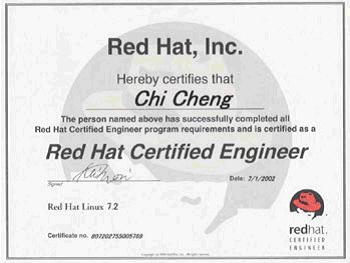
You might not guess how Lady Luck connected to my exam. Haha, let me tell the story from the beginning. December 29, 2004. It was freezing cold. I got up early in the morning, ready to face my destiny. The bus window near my seat was broken, and I sat right next to it — it was so cold my feet went numb. I told myself to just tough it out. At 8:40 I arrived at the exam center. One fellow test-taker was already there; the rest arrived shortly after. I thought to myself — what a twist of fate that we all ended up here together. I’m an introvert by nature, but that day I was surprisingly relaxed. I started chatting with everyone, greeting new arrivals with a smile and a hello. In conversation, they brought up the retake fee. I had known it was 1,000 yuan, but starting September it had risen to 2,200 yuan. That’s when the pressure hit — if I failed, I’d have neither the money nor the time for a retake, and even the soonest retake would be after the New Year. I started consoling myself: if I fail such a difficult exam, my parents wouldn’t blame me. At 9:30, the 13 of us entered the exam room. The morning session was troubleshooting — any machine, all of them had faults anyway. I sat in my usual seat. The examiner was a man around 30. The instructor from my training had told me that in China, there were only five RHCE examiners, all board members of the Wenhua School, and one of them was the vice chairman. The examiner explained the rules and handed out the exam requirements: you pass the morning session at full marks if you can repair a faulty machine to meet the specifications on the paper. The rules put enormous psychological pressure on candidates. Let me briefly explain. The morning session was split into two parts. Part 1 had 8 questions — if you passed all 8 at full marks, you could skip Part 2. If you ran into trouble in Part 1, you could, with the examiner’s consent, move on to Part 2. Your Part 1 score would be frozen. If your combined score from Part 1 and Part 2 didn’t reach 80%, you’d be disqualified from the afternoon session. As soon as the paper was handed out, I was so nervous I wrote my name in the examiner’s name field. Sweat. I solved 7 questions in 30 minutes — just one left. But I hit a wall. I racked my brain and got nowhere. After an hour, I told the examiner I wanted to start Part 2. He froze my Part 1 score at 70%. I started Part 2 — luckily, the two questions in Part 2 were easy. The examiner said I had passed the morning session. I said thanks and immediately left that suffocating exam room. If Part 2 had tripped me up too — I don’t even want to think about it. I later learned that two people had been eliminated in the morning session. The afternoon was server configuration, and scores wouldn’t be known for three days. You needed 70% accuracy to pass. I was even more nervous. Facing four pages of English exam paper, my head started to ache. Then the real killer arrived — a gap in my review. There was a section of the exam I hadn’t prepared for at all. I hadn’t flagged it as important because it was a C/S setup. I never imagined that this time they’d use the examiner’s own machine as the server to build this environment. Roughly estimating, nearly 40% of the content was connected to it. I was doomed — if this part went wrong, my score would definitely fall below 70%. No time for more thinking. I sped through the rest to save time for this section. After finishing everything else, I revised this section four more times before it met the requirements. There were still many unresolved issues in other parts. I figured, fine — if I don’t pass this time, there’s always next time. Mom and Dad won’t blame me. December 30, 2004. My birthday. I was alone in my dorm, packing up. I’d already bought a train ticket for the next evening. That was it for the year. No more thinking. Go home. Back to Inner Mongolia. After arriving home, I went online and checked my email. There was an English message. When I opened it, my heart pounded so fast — could this be the notification I’d been waiting for? It read: Congratulations — you are now certified as a Red Hat Certified Engineer! I read it again and again. Ecstatic — I had passed with an ultra-low score of 69.6%. This time, the dawn of Lady Luck had finally lit up the road ahead. I had received the best 20th-birthday gift I could ever hope for.
10 Being an RHCE
On February 24, 2005, I returned to Beijing happily after the New Year. The next day after arriving, I went to the exam center to pick up my certificate, and I learned about the state of RHCE exams. Out of the 13 of us who took the exam, 6 received the RHCT certified technician certificate. Two of us — including me — achieved our dream and earned the RHCE certified engineer title. The pass rate for this exam was under 20%. There are about 10 exam sessions per year. Roughly 100 people pass RHCE in Shanghai and Beijing combined each year. The total number of RHCE holders in China probably does not exceed 500. To my knowledge, no woman has ever taken this certification. I may not be the youngest person to pass (I hadn’t yet turned 20 at the time of the exam), but I’m surely the one with the lowest academic credentials. I thought with this certification, finding a job would be a breeze.
11 The Perfect Job
On February 26, 2005, I went to the China International Exhibition Center job fair. So many people. I did a big loop around Hall 8 and submitted 7 résumés. My résumé was brutally honest — full of shortcomings: low education, young age, no work experience. The only bright spot was that I had passed the RHCE exam. Of the companies I applied to, only one had even heard of this certification. So frustrating. A week later, not a single phone call. I had no choice but to accept that there was no hope. I started job hunting again. I went to the Haidian talent market — out of 110 recruiting companies, only 2 were in my field. After submitting my résumé, I went home to wait. My friend said if no call came within three days, it was over. On the fourth day of dejection, the phone rang in the morning — I had my first-ever job interview. In the interview, the manager asked about my skills. I gave a brief overview. He said they used Unix, and if hired, I’d have to learn from scratch. I said no problem — Linux and Unix are very similar, I could pick it up quickly. We discussed salary. He said the role wouldn’t get going right away — the initial period would be mainly learning, with a three-month probation period at 1,000 yuan per month. I thought, the money isn’t much, but it’s enough to support myself, and I’d get to learn something new — exactly what I wanted. I could always negotiate with the boss later. After getting their notice, I started on my first day. All I did was read materials. They were an HP distributor, and everything they dealt with was HP mid-to-high-end servers and disk arrays. I thought, awesome — I get to work with this stuff. This is exactly what I wanted to learn. The first two days I barely spoke, since I didn’t know anyone. On the third day, the boss held a meeting with the three new hires. He introduced us to the other employees and said that going forward, one of us would be cut — so study hard. The other two were fresh computer science graduates who had never used Unix and needed to learn from scratch. I figured my learning curve would be much shorter, so I didn’t have to worry about being weeded out. I studied at a relaxed pace. By noon, I was already on friendly terms with the technicians. By the afternoon, I was even discussing Unix technical issues with them. In the middle of our chat, the boss suddenly came out and said: ‘If you want to talk tech, go to the meeting room — not here.’ I figured our voices had gotten a bit loud and disturbed him, so we stopped talking. Through our conversations, I learned what my job would actually entail: installing a Unix system on the machines customers purchased, and that was pretty much it. Those higher-end things like disk arrays and network storage — we wouldn’t touch those. HP’s own technicians would handle that. That’s when I realized why the pay was so low. In my eyes, this wasn’t much different from assembling computers in Zhongguancun. Near the end of the day, two managers called me in for a talk. They said I didn’t need to come back tomorrow. I said goodbye and that was the end of my first job. I figured the boss must have realized that even if he didn’t fire me now, I’d leave on my own soon enough. So he might as well save himself the wages and cut me right away. They were looking for long-term laborers who would stay for a long time. I didn’t fit the bill. Source: examda – Linux Certification Exam