

The LAMP (Linux-Apache-MySQL-PHP) web architecture is a popular Web framework internationally. The stack includes: the Linux operating system, the Apache web server, the MySQL database, and the Perl, PHP, or Python programming languages. All components are open-source software, forming a mature architecture framework. Many popular commercial applications are built on this architecture. Compared to the Java/J2EE architecture, LAMP offers rich Web resources, a lightweight footprint, and rapid development. Compared to Microsoft’s .NET architecture, LAMP boasts advantages in versatility, cross-platform compatibility, high performance, and low cost. Therefore, whether considering performance, quality, or price, LAMP is the preferred platform for enterprises building websites.
For website system architectures handling high traffic and high concurrency, in addition to using high-performance hardware like servers, load balancers, and CDNs, the following software architecture links require special attention: using a high-performance Operating System (OS), a high-performance Web Server, a high-performance Database, and efficient programming languages. Below, I will discuss each of these points.
Operating System
The Linux operating system has many different distributions, such as Red Hat Enterprise Linux, SUSE Linux Enterprise, Debian, Ubuntu, CentOS, etc. Each distribution has its own characteristics, for example, RHEL’s stability and Ubuntu’s ease of use. Based on considerations of stability and performance, choosing CentOS (Community ENTerprise Operating System) is an ideal solution.
CentOS (Community ENTerprise Operating System) is one of the Linux distributions. It is a streamlined, free version of RHEL/Red Hat Enterprise Linux and shares the same source code. However, enterprise editions like RHEL and SUSE LE provide paid upgrade services that cannot be upgraded online for free. Therefore, servers requiring high stability at no cost can use CentOS as a substitute for Red Hat Enterprise Linux.
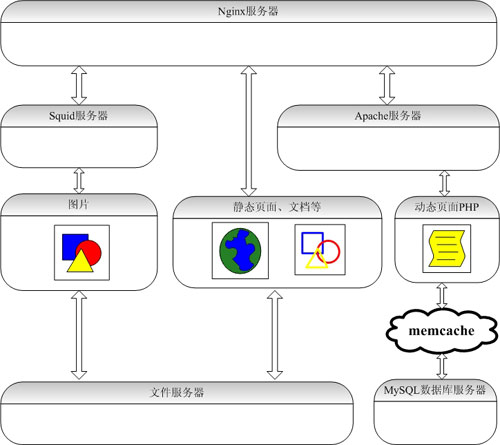
LAMP Website Architecture Diagram
Web Server, Caching, and PHP Acceleration
Apache is the core Web Server of the LAMP architecture, with advantages in being open source, stable, and feature-rich in modules. However, Apache’s drawback is that it is somewhat bloated, incurring high memory and CPU overhead with some performance loss. It is not as efficient as some lightweight web servers (like nginx), whose response capability for static files is much higher than that of Apache servers.
Apache as a Web Server is the best choice for serving PHP. If the traffic volume is very large, nginx can be used to handle non-PHP Web requests. nginx is a high-performance HTTP and reverse proxy server, renowned for its stability, rich feature set, sample configuration files, and low consumption of system resources. Nginx does not support dynamic languages like PHP or CGI, but it supports load balancing and fault tolerance and can cooperate with Apache. It is the preferred lightweight HTTP server.
There are also multiple solutions for Web server caching. Apache provides its own caching module, and the additional Squid module can also be used for caching. Both methods can effectively improve Apache’s access response capability. Squid Cache is a Web caching server that supports efficient caching. It can act as a front-end cache server for the web page server to cache related requests to speed up the Web server. By placing Squid in front of Apache to cache dynamic content generated by the Web server, the web application only needs to set the page expiration time appropriately. If the traffic volume is enormous, consider using memcache as a distributed cache.
For PHP acceleration, the eAccelerator accelerator is used. eAccelerator is a free, open-source PHP accelerator that optimizes and caches dynamic content, improving the caching performance of PHP scripts. It nearly eliminates server overhead when PHP scripts are in a compiled state. It also optimizes scripts to speed up their execution efficiency, potentially increasing PHP program code execution efficiency by 1-10 times.
Specific solutions include the following:
1. squid + Apache + PHP + eAccelerator
Use Apache to serve PHP and use squid for caching. Requests for HTML or images can be returned directly to the user by squid. Many large websites adopt this architecture.
2. nginx/Apache + PHP (fastcgi) + eAccelerator
Use nginx or Apache to serve PHP. PHP runs in fastcgi mode, achieving higher efficiency.
3. nginx + Apache + PHP + eAccelerator
This solution combines the advantages of nginx and Apache, using Apache to serve PHP, while nginx is responsible for parsing other Web requests. It uses nginx’s rewrite module, and the Apache port is not exposed externally.
Database
Among open-source databases, MySQL is the top choice in terms of performance, stability, and functionality, capable of handling data storage at the million-record level. In the initial stages of a website, MySQL and the Web server can be placed together. However, when traffic reaches a certain scale, the MySQL database should be separated from the Web Server and run on a dedicated server, while maintaining a stable connection between the Web Server and the MySQL server.
When database access reaches an even greater level, solutions like MySQL Cluster or database table sharding can be considered.
Overall, the performance of an LAMP architecture website will significantly outperform