

[51CTO Special Report] What Is BSM
BSM (Business Service Management) is an integration and complement of IT and business management approaches. Based on the ITIL theoretical foundation, it enables the convergence of IT management and business services. BSM can consolidate required IT operational information from different monitoring systems (including third-party ones), bringing enterprises advantages in IT services that translate to competitive edge:
· Reposition enterprise IT systems from a business perspective, ensuring IT services are manageable and measurable. Link IT management with business performance to align interests of both sides and improve customer satisfaction;
· Centered on the ITIL process framework, by implementing ITIL service delivery and service support processes, provide managers with an at-a-glance visual view of IT service status, simplifying understanding of IT systems;
· Allow enterprise managers to spend more time on decision-making rather than navigating complex, tedious IT details.
The Three Pillars of BSM: People, Process, and Technology
People
Refers to the need for enterprises to clearly define the roles and responsibilities of IT support personnel, specify their skill levels, and build an internal talent pipeline within the IT department. The quality and caliber of IT support personnel ultimately determine the quality of the entire IT service management implementation.
Process
Refers to business processes as logically grouped activities that regularly provide users with repeatable business functions; they have clear process goals, can achieve expected outcomes, and their results are measurable. ITIL is a mature process model through which enterprises can put these best practices into action.
Technology
Refers to effective technical means that enable enterprises to: monitor IT system availability and performance; monitor the quality of IT department delivery against SLA requirements; manage configurations and track changes to IT system configurations; diagnose and quickly pinpoint root causes of problems and prescribe targeted fixes; predict and prevent, forecasting resource usage and taking relevant preventive measures; provide dashboards to visualize the enterprise IT service model, IT service reports and metrics, network topology, etc., allowing leadership to more easily understand the current state of IT systems and make decisions.
Only through tight coordination of these three elements can the overall quality of IT service management be improved and best practice results be achieved.
BSM’s Limitless Potential
In recent years, in the realm of IT management, BSM (Business Service Management), which helps users achieve the integration of IT and business, and the convergence of IT resources and business services, has rapidly become a focal point of intense attention. However, in the BSM practices of Chinese enterprises, some misconceptions and practical pitfalls make BSM seem more like an unreachable castle in the air. Clearly, for enterprise IT operations management, the move towards BSM must start from the organization’s actual situation, moving beyond misconceptions to find practical and feasible approaches.
In terms of IT operations management, compared to the mature, standardized development paths of foreign enterprises, Chinese companies, influenced by their own development and business service models, exhibit their own characteristics in IT management and operations.
In the initial stage of informatization, Chinese enterprises built IT systems to improve production efficiency, and IT system operations were limited to establishing a dedicated IT department to ensure stable system operation. As applications evolved, Chinese enterprises successively invested in building networks, storage, security, and many other IT systems, and IT operations gradually transitioned from manual management to unified, centralized management.
As informatization progresses to higher stages, enterprises encounter situations where if the IT department lacks fast, effective coordination mechanisms and necessary auxiliary management tools, a chaotic ‘firefighting’ scenario ensues; application system management requires specialized technical personnel, and the escalating skill requirements mean the IT department needs professional application monitoring software that can visually monitor all mainstream applications, discovering and resolving application system issues at first glance; internet companies place great importance on end-user experience but suffer from the lack of proper monitoring mechanisms to understand it in real-time dynamically; IT departments focus solely on technology and fail to form a good interaction and communication with business departments; the experience of IT department problem-solving cannot be accumulated into the enterprise knowledge base and dissipates with personnel turnover. Some enterprises begin to focus on correlating IT systems with business applications, implementing dynamic allocation of IT resources, and deriving benefits from management. At this point, IT operations management becomes more complex and difficult, entering a business-driven stage. This is the original intent of BSM’s proposition for IT and business service convergence.
From a practical standpoint, the IT operations management of most Chinese enterprises remains at a rudimentary level, and the role of IT systems in supporting business is quite limited. Truly implementing BSM is no easy task.
The Convergence of IT and Business
Considering the current state of IT in society, business application systems within Chinese enterprise user IT environments are continuously expanding, and business dependency on these systems is gradually increasing. How to circumvent potential system risks and ensure the efficient and secure operation of enterprise information platform systems has become the top priority for enterprise IT operations management. Once the existing IT operations management system can no longer meet the needs of the enterprise’s increasingly developing and complex business system applications, it becomes a bottleneck hindering forward progress. If enterprises wish to reap greater returns from IT systems, they must first lay a solid foundation in IT operations management to better integrate IT and business.
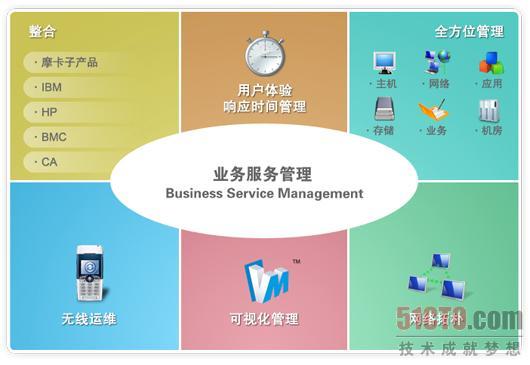
The Scope Covered by BSM
A good operations management software can not only help enterprises solve related problems but also assist them in integrating IT and business faster and better, thereby realizing Business Service Management. And a good BSM software should possess the following capabilities:
Business Service Management
View IT from a business perspective, correlating business with complex IT resources, so that if a business service becomes unavailable, the fault cause can be located top-down. Estimate the impact of system events on business and their severity based on predefined weight ratios, and trigger corresponding fault resolution processes according to impact and priority.
Network Topology Management
Ability to automatically discover network topology and present it in multiple forms, associating topology views with device panels to monitor device network traffic, asset information, interface performance metrics, etc. Provide a VISIO-style topology editing interface for easy drawing of management topology maps, facilitating fault location and analysis from both geographic and functional perspectives.
Visualization Management
Visually monitor host systems, network devices, and applications, dynamically displaying overall operational status in real-time, establishing critical process monitoring, and continuously tracking key business statuses.
Wireless Operations
Through mobile devices like smartphones, achieve AnyWhere, AnyWhat