

Data breach incidents have put all enterprise IT managers on edge. How to protect sensitive corporate data from leakage has become a mandatory lesson for today’s IT administrators. Here are eight things we’ve summarized that enterprise IT managers should understand when protecting corporate data:
1. Every Company Has Sensitive Data.
Sensitive data refers to information you don’t want unauthorized individuals to see. Regardless of company size, every business has this type of data. This includes employee salaries, bank accounts, customer credit card accounts, trade secrets, and medical records.
2. Data Loss Happens All the Time.
For decades, the IT industry has focused on enabling users to share data faster and more conveniently. We now expect complex information to spread rapidly across the globe, making it accessible to users anytime. However, the downside is that it makes data easy to lose. For instance, most people have experienced sending an email to the wrong recipient. Furthermore, it only takes seconds to upload files to a USB drive or CD, and such storage devices are also easily lost.
Additionally, the now-ubiquitous mobile devices like laptops, tablets, and smartphones present the same risk. 75% of all data loss incidents are accidental, making this a clear focal point for security.
3. Malicious Actors Are Coveting Your Data.
The era of writing viruses for fame is over. Many malware programs today are designed to steal undetected data. Some data, like credit card accounts, obviously holds value for criminals. However, their target range is broadening, attempting to profit from email addresses, corporate intellectual property, and other avenues. Of course, hackers aren’t the only data thieves. Companies must also guard against employees stealing data, USB storage devices, and other hardware containing sensitive information.
4. Losing Sensitive Data Can Bring Severe Consequences.
Many countries and industries have financial penalties for data loss. Even if you manage to avoid fines, the consequences can still be severe. This includes the costs of remediating a data breach, such as notifying affected parties and shielding them from losses. Worse, leaked R&D secrets could fall into competitors’ hands, causing long-term impact to the business. Reputational damage is another major threat, as consumers are increasingly aware of the destructive nature of data loss.
Handling things internally with employees isn’t easy either. Imagine what would happen if payroll spreadsheets or merger and acquisition plans were leaked? This undermines employee trust and identity, and staff turnover also impacts the business.
To calculate the potential financial loss from a corporate data leak, first consider the amount of sensitive information you hold. Then think about what you would lose if this fell into the wrong hands. For example, if your customer database is a primary asset, what would you lose if an employee stole the data for a competitor? Also, factor in remediation costs, such as informing customers you lost a CD containing their credit card accounts, plus the resulting loss of trust.
5. Data Encryption Isn’t a One-Size-Fits-All Solution.
If your data is encrypted, unauthorized users cannot read it. But every company’s encryption needs are different. The correct approach involves considering multiple factors, including data type, how data is manipulated (e.g., sent via email or shared through third parties), your industry, and the resources you can control. Highly regulated industries require stricter, comprehensive reporting solutions. Other industries might only need to ensure a lost laptop doesn’t easily expose data.
Data exists in three states:
a) At rest: Such as data saved on a computer or server;
b) In use;
c) In transit: Such as data transmitted via email or transferred via a USB drive.
When you think about how to protect sensitive data, you need to consider which data falls into these three states. If you store large amounts of data on laptops and USB drives, encrypting the devices is necessary. If you need to send attachments containing sensitive information, encrypting the email is necessary.
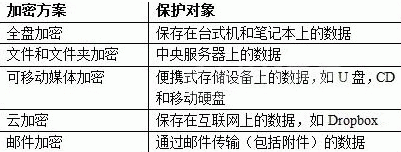
6. It’s Actually Neither Cumbersome Nor Time-Consuming.
Companies can choose from many encryption solutions. These range from straightforward encryption (automatically integrated into endpoint security) to government-grade solutions.
7. Encryption Is Only Part of the Solution.
Encryption is a core part of protecting data, but user education is equally important. Data is meaningful only when people use it; if people don’t access it, it holds little value.