
DNS Round Robin
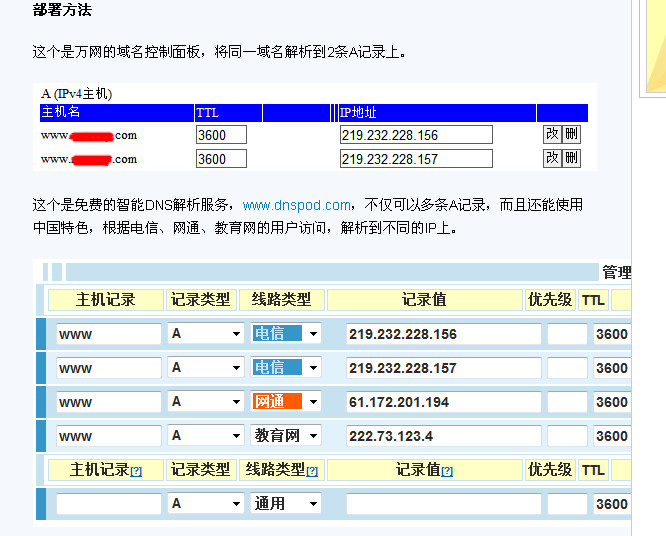
Most domain registrars support resolving multiple A records, which is essentially DNS round robin. The DNS server distributes resolution requests to different IPs in the order of the A records, thus achieving simple load balancing.
Pros
Virtually cost-free, as domain registrars typically offer this type of resolution for free;
Easy to deploy 鈥?besides simply scaling out the network topology, a new web server only needs an additional public IP address.
Cons
Health checks: if a server goes down, the DNS server has no way of knowing and will still distribute traffic to it. Modifying DNS records takes at least 3鈥? hours, or even longer, to fully propagate;
Uneven distribution: if web servers have different configurations and can handle different levels of pressure, DNS resolution still distributes access evenly. DNS does have allocation algorithms 鈥?it can assign based on the fewest current connections, set Rate-based weight assignment, etc. 鈥?but the vast majority of DNS servers do not support this today;
Session persistence: for websites requiring authentication, this is fairly fatal without modifying the software architecture, because DNS resolution cannot persistently tie a verified user鈥檚 access to the same server. Although local DNS caching exists, it is hard to guarantee that the local DNS cache does not expire during the user鈥檚 visit and re-query the server, pointing to a new server. In that case, the user information saved on the original server cannot be carried over to the new server, and the user may be required to re-authenticate. As switches happen back and forth over time, each server ends up storing different pieces of user information, which is also a waste of server resources.