

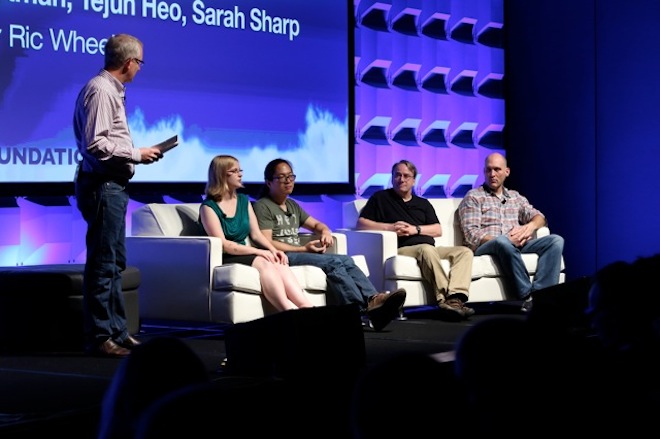
Sarah Sharp (pictured center) and Linus Torvalds (second from right) at LinuxCon. Photo: Linux Foundation
Last Wednesday, Linus Torvalds and Intel programmer Sarah Sharp finally sat face-to-face. This was their first public meeting since the email controversy earlier this summer, where they publicly clashed on the Linux kernel mailing list over whether politeness should be expected when dealing with Linux programmers.
But during this in-person meeting, no sparks flew between them. They didn’t even bring up the topic Sharp had just raised this summer.
At this year’s LinuxCon in New Orleans, which was livestreamed, Sharp avoided all controversial topics in her talk. However, she still conveyed to the audience that Linux needs to find new ways to attract more contributors to its heart—the kernel.
Speaking about contribution volume, she said, “We have brought many people into kernel development, but a lot of them only do ‘one-off’ work. So, we really need to find a way to get people to do more and stay longer in kernel projects. We need more one-on-one mentoring and apprenticeship.”
‘We need to find a way, like one-on-one mentoring, to get people to do more and stay longer in kernel projects.’
— Sarah Sharp
Torvalds acknowledged that while kernel work seems difficult in some respects, actually writing code and getting it merged into the kernel is quite easy. “People always say how hard the kernel is, but at the same time, just look at the data—it’s hard to say it’s inaccessible.”
Figures released by the Linux Foundation show that since 2005, over 10,000 developers have contributed to the Linux kernel. That’s a massive number, but the community is still far from diverse and urgently needs fresh blood. Sharp is one of the very few women working on kernel projects; she estimates that women make up only 1%-2% of kernel developers. The number of ethnic minority programmers is also unclear.
Back in July, Sharp pointed out that some programmers might feel uncomfortable with the rude and abrasive atmosphere in the kernel circle. If someone can’t adapt to this culture, long dominated by white men in the development field, they can feel very stifled and frustrated.
Torvalds has a habit of being abrasive and unforgiving with his criticism, which led Sharp to publicly challenge him on the kernel mailing list this summer. Sharp wrote in the mailing list post: “Linus, you are full of profanity, openly trampling on others’ feelings. You are one of the worst offenders, bar none.”
But Torvalds has said what he dislikes most is being “proper,” and the non-corporate, free-form nature of Linux helps him escape that. From home to office, from garage to bathtub, he can control the most important core component of Linux from anywhere on Earth.
Sooner or later, Torvalds and Sharp will hash out their differences. Perhaps at next month’s invite-only Linux Kernel Summit in Edinburgh they will have a good talk, though we likely won’t get to hear it.
Although Linux is largely written by white men, the community is making slow progress toward change. Sharp herself coordinates an internship program to help women join open-source projects. (At the conference, she mentioned that two of her female programmer friends were also attending, hoping to find jobs there.) Meanwhile, for the first time ever at LinuxCon, women appeared at the luncheon.
Around 60 women attended the conference this year. Jennifer Cloer, a spokeswoman for the Linux Foundation, said, “I really didn’t expect to see so many women…”.
Oh, and one more thing worth mentioning. Since last year, LinuxCon has been offering conference T-shirts in women’s sizes.
Correction 9/19/2013 17:55 ET: An earlier report stated this was the first year LinuxCon provided women’s T-shirts. They actually started back in 2012. The error is regretted.
via: http://www.wired.com/wiredenterprise/2013/09/linuxcon/