

【LVS】
Using clustering technology and the Linux operating system to build a high-performance, high-availability server offers excellent scalability, reliability, and manageability.
The characteristics of LVS are:
1. Strong load resistance. It operates at Layer 4 of the network solely for distribution, generating no traffic of its own. This also makes it the top performer among load balancing software.
2. Low configurability is both a drawback and an advantage. Because there isn’t much to configure, it doesn’t require extensive hands-on management, greatly reducing the chance of human error.
3. Stable operation, with its own complete hot-standby solutions, such as LVS+Keepalived and LVS+Heartbeat. However, in project implementations, we most commonly use LVS/DR+Keepalived.
4. No traffic generation ensures the load balancer’s I/O performance is not affected by large traffic volumes.
5. Broad application scope; it can load balance all types of applications.
6. The software itself does not support regular expression processing and cannot perform dynamic/static content separation, which is a notable drawback. In fact, many websites today have a strong demand for this feature, which is where Nginx/HAProxy+Keepalived excel.
7. If the website architecture is very large, implementing LVS/DR+Keepalived can be quite complex, especially if there are Windows Server machines in the backend. The implementation, configuration, and maintenance processes become more complicated. In comparison, Nginx/HAProxy+Keepalived is much simpler.
【Nginx】
1. Works at Layer 7 of the network and can implement traffic routing policies for HTTP applications, such as by domain name or directory structure. Its regular expression rules are more powerful and flexible than HAProxy’s, which is one reason many people prefer it.
2. Nginx has minimal network dependencies; theoretically, if you can ping it, you can load balance it. This is another of its strengths.
3. Nginx is relatively simple to install and configure, and convenient to test.
4. It can handle high load pressure stably, generally supporting tens of thousands of concurrent connections.
5. Nginx can detect internal server failures through port checks, such as based on the HTTP status codes returned by the server processing web pages or timeouts, and will resubmit failed requests to another node. However, a drawback is that it does not support URL-based detection.
6. Nginx only supports HTTP and Email, which significantly limits its application scope—this is its weakness.
7. Nginx is not just an excellent load balancer/reverse proxy software; it is also a powerful Web application server. The LNMP stack is now a very popular web architecture, rivaling the previously dominant LAMP stack, and it performs very well in high-traffic environments.
8. Nginx is increasingly mature as a web reverse acceleration cache. Many users have already deployed it in production environments and report good results, with speeds faster than traditional Squid servers. Those interested might consider using it as a reverse proxy accelerator.
【HAProxy】
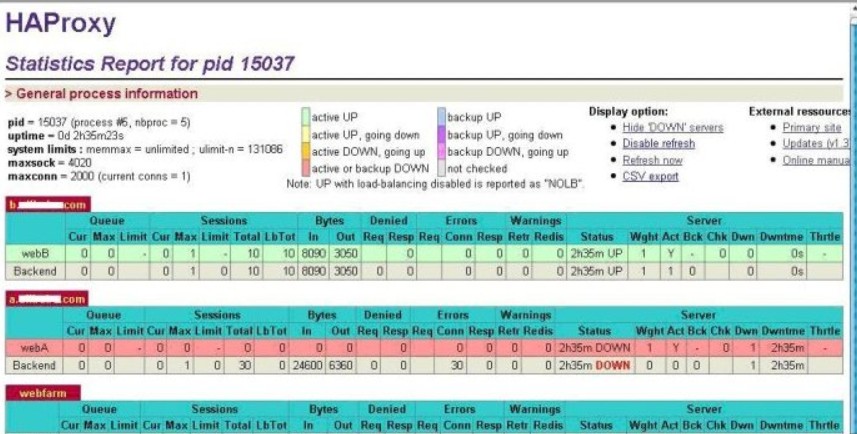
1. HAProxy supports virtual hosts. Some friends previously said it didn’t; I’m taking this opportunity to correct that here.
2. It can compensate for some of Nginx’s shortcomings, such as session persistence and cookie-guided routing.
3. Its support for URL-based health checks of backend servers is very helpful for detecting issues.
4. Like LVS, it is purely a load balancing software. In terms of sheer efficiency, HAProxy offers superior load balancing speed compared to Nginx and also outperforms Nginx in concurrent processing.
5. HAProxy can load balance MySQL reads, performing health checks and distributing traffic across backend MySQL nodes. However, when the number of backend MySQL slaves exceeds 10, its performance is not as good as LVS, so I recommend LVS+Keepalived for such scenarios.
6. HAProxy’s algorithms are increasingly diverse, with the following 8 types available:
① roundrobin: Simple round-robin, which is standard for most load balancers.
② static-rr: Based on assigned weights; recommended to pay attention to this.
③ leastconn: Prioritizes the server with the fewest connections; recommended.
④ source: Based on the requesting source IP. This is similar to Nginx’s IP_hash mechanism and is used as a method to solve session persistence issues; recommended.
⑤ ri: Based on the request URI.
⑥ rl_param: Based on request URL parameters; ‘balance url_param’ requires a URL parameter name.
⑦ hdr(name): Locks each HTTP request based on HTTP request headers.
⑧ rdp-cookie(name): Locks and hashes each TCP request based on a cookie(name).