
Before diving into the details ofRAID solutions, let’s first understand the benefits of RAID and then comprehensively introduce RAID solutions, hoping this will be useful to you. RAID comes in various forms, all serving as the backbone of high availability and high-performancestorage. The earliest applications of RAID devices can be traced back to the late 1980s, and today, RAID has become such a widespread and critical part of our IT lives that many people have forgotten what the acronym actually stands for.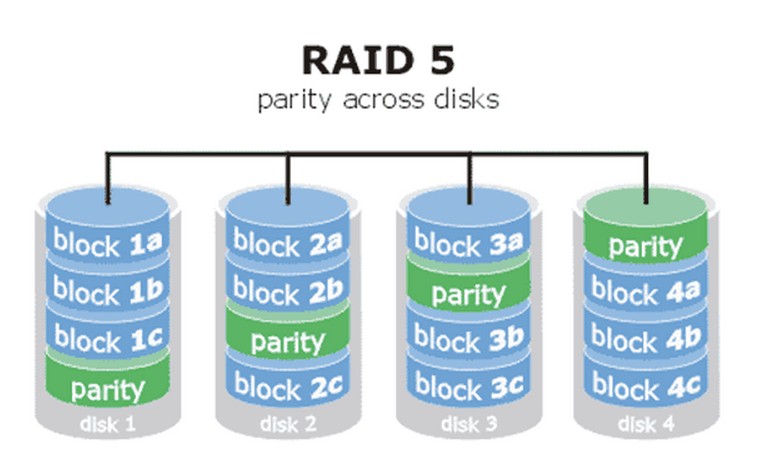
RAID was proposed in 1988 by Professor D.A. Patterson at the University of California, Berkeley. RAID stands for Redundant Array of Inexpensive Disks, also referred to as a “disk array”. Later, the letter ‘I’ in RAID was changed to Independent, making it “Redundant Array of Independent Disks,” but this was just a name change; the core substance remains the same. Simply put, RAID technology uses a combination of multiple hard drives to provide high efficiency and redundancy.
RAID Benefits
Adopting RAID brings significant benefits tostorage systems(or the built-in storage ofservers). The greatest advantages are improved transfer rates and fault tolerance.
RAID improves transfer rates by using multiplediskssimultaneously. RAID dramatically increases a storage system’s data throughput by storing and reading data on multiple disks at the same time. In RAID, manydisk drivescan transfer data simultaneously, and since these drives logically function as a single disk drive, RAID can achieve speeds several, dozens, or even hundreds of times faster than a single drive. This was also the original problem RAID was designed to solve. At the time, CPU speeds were increasing rapidly, but the data transfer rates of disk drives could not be significantly improved, so a solution was needed to resolve this conflict. Ultimately, RAID succeeded.
Through data verification, RAID provides fault tolerance. This is the second reason for using RAID, as ordinary disk drives cannot offer fault tolerance, if you don’t count the CRC (Cyclic Redundancy Check) codes written on the disk. RAID fault tolerance is built upon the hardware fault tolerance of each individual disk drive, thus providing higher security. Many RAID modes feature relatively comprehensive mutual verification/recovery measures, or even direct mutual mirror backups, thereby greatly enhancing the fault tolerance of the RAID system and improving the system’s stability and redundancy.
There are two types of RAID solutions: hardware RAID solutions and software RAID solutions. Hardware RAID solutions are fast and stable, effectively providing high levels of hard disk availability and redundancy, but their consistently high prices can be daunting. Windows 2003 offers built-in software RAID functionality that can implement RAID-0, RAID-1, and RAID-5. Software RAID is not only very convenient to implement but also saves a significant amount of valuable funds, making it a truly practical new feature of Windows 2003 Server. Of course, the performance and efficiency of software RAID cannot be compared to that of hardware RAID.