

Data center operations management has long been a focal point for enterprise IT administrators. The management tasks are complex and diverse, encompassing system maintenance for compute nodes, network management between nodes, and the upkeep of various business systems 鈥?all of which fall under the IT manager’s purview.
With the introduction and proliferation of the “cloud computing” concept, data center management has once again been thrust into the spotlight by numerous media outlets and vendors. In this new era, data center control and management have become a hot topic of discussion. While data center management is nothing new for enterprise IT administrators, its renewed attention 鈥?and even hype 鈥?stems from the rapid evolution and development of data centers themselves, which has led to constantly increasing demands and difficulties in their management and control.
Data Center Evolution
What direction are enterprise-level data centers heading? This question is no longer hard to answer. As user demand for information technology continues to grow, enterprise data centers are moving towards greater consolidation and centralization. Because of this, technologies and products like virtualization and blade servers are being increasingly adopted by users, and the emergence and development of the cloud computing concept has further accelerated this trend. Many large enterprise users have already established highly centralized, large-scale data centers at their corporate headquarters, using B/S-based application systems to integrate branch office data centers and thereby solve information silo issues. Against this backdrop, data center management faces new challenges.
New Challenges in Data Center Control and Management
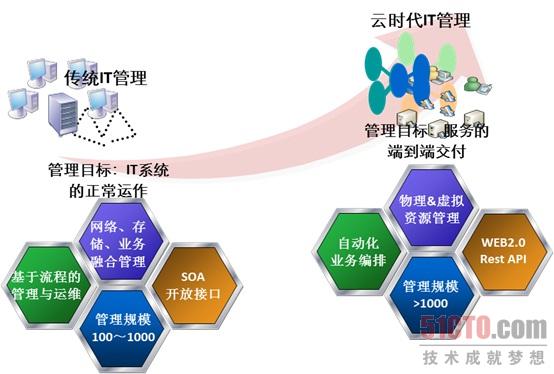
In the early days, IT administrators emphasized two aspects of data center management: first, maintaining all components of the data center to ensure stability; second, when problems occurred, quickly locating and resolving them to minimize downtime. For many small and medium-sized enterprises, such operational practices were sufficient to meet their daily needs.
As data centers grew to a certain scale, the concept of process-oriented operations was introduced on top of the previous requirements, enabling the operations work to run more efficiently and rapidly, and improving user service satisfaction through these standardized processes. For many large enterprises, this was also a solid operational model.
With the arrival of the cloud computing era, data center development has risen to a completely new level. Consequently, the overall goals of operations work have undergone a fundamental change, introducing new elements to IT management.
The core of traditional data center operations was “solving the current problem” 鈥?how to prevent problems from occurring, how to swiftly locate and fix them when they did, and what procedures to follow when issues arose…
Now, when a data center reaches cloud scale, the management objects and focus of operations work have shifted. The proliferation of virtualized devices has dramatically increased both the workload and complexity of management, making virtualization and automation the key focus for data center administrators.
Object-Oriented Adjustment: Resource Control Becomes the Core of Operations
The most distinctive feature of a cloud-era data center is the extensive application of virtualization technology, which changes the objects being managed. Previously, devices were physical, and their locations were relatively fixed, making management more intuitive. The result of virtualization technology is the “pooling” of these resources, turning all managed objects into virtual, logical entities that can be migrated flexibly. The visibility of a resource’s physical location within the data center becomes challenging.
On the other hand, the boundaries between networks and servers become increasingly blurred, creating issues in the collaborative scheduling of network and computing resources. When creating or migrating a VM, the normal operation of the VM host depends not only on reasonable resource scheduling on the server but also on the reasonable scheduling of network connections. Bridging the gap between network and compute, achieving integrated resource management and intelligent scheduling, will be the key to realizing business-based scheduling in the data center and ultimately achieving automation.
Furthermore, in server virtualization applications, VM migration inevitably causes the dynamic nature of their access locations. This requires physical network configurations to provide on-demand management capabilities to ensure the network connectivity, security, and reliability requirements of VMs. Therefore, to better control resources, accurately identify the connections between VMs and physical switches, and solve resource migration problems are critical issues that data center managers must address.
In summary, in a cloud-era data center, IT managers must be able to understand their IT resource status at all times, know the correspondence between virtual machines and physical servers at any moment, and clearly establish the relationships among physical servers, virtual machines, physical networks, and virtual networks, while linking these elements to the enterprise’s application systems.
Business-Centric Management Philosophy: Automation and End-to-End Service Delivery
As the number of elements to manage increases, the directions that cloud computing data center operations must consider become increasingly diverse. In addition to managing daily network and physical server devices, operations personnel now focus on virtual machines, virtual networks, and various business application processes. In this context, bridging the gap between network and compute to achieve integrated resource management and intelligent scheduling will be the key to business-based scheduling and, ultimately, automation in the data center.
On February 24, 2012, under the theme “Intelligent Integration, Changing with the Cloud,” H3C launched its iMC Data Center Management 2.0 solution (iMC DCM2.0 for short), which emphasizes the integrated mastery and intelligent control of overall IT resources.
With the newly released iMC DCM2.0 solution, operations personnel can achieve, within a single interface, not only the total management and control of the data center’s physical layer found in traditional IT operations systems but also the provisioning and operation of virtual machines and virtual networks. Furthermore, the iMC DCM2.0 solution provides a highly convenient correlation between virtual and physical machines. Even if a VM migrates, operations personnel can easily find out where the relevant virtual machine has moved, which virtual machines are running on different physical servers, how many network resources each virtual machine occupies, and so on. By integrating with the API interfaces of various virtualization products, the iMC DCM2.0 solution can generate real-time physical topology maps for virtual machines, organically connecting traditional physical topologies with virtual machines. Through these means, even when facing a cloud computing data center, operations personnel can clearly understand the overall operational status, solving the operational bottleneck for managing cloud data centers.
Through integrated and intelligent management, the iMC DCM2.0 solution addresses the IT resource control issues that data center managers care about most. At the same time, it also boasts strong security and openness. It not only has comprehensive security control measures, supporting policies like configuration compliance checks and device operation audits to make user systems more secure, but also, through its open-architecture SOA platform, can easily interface with third-party systems. These features all enable iMC DCM2.0 to help users better achieve the delivery of various services.
Summary:
With the advancement of IT technology, data center management has entered a new era. Unified management of IT resources and the achievement of end-to-end service delivery have become the core of cloud computing IT control. Against this backdrop, both relevant operations solution providers and enterprise IT managers must promptly recognize the importance of IT resources to operations. ”