

<<
The rapid development of IT and the IT industry, coupled with the current global financial instability, has made effective IT management and ensuring smooth business operations the top priority for organizational IT leadership. As the saying goes, “By other’s faults, wise men correct their own.” Drawing on the best practices and management experience of other organizations is undoubtedly a shortcut to achieving twice the results with half the effort.
1 Current State of IT Operations Management at Home and Abroad
The rapid development and widespread application of IT caught many people by surprise. Generally speaking, information technology management has transitioned from resource management to system management and then to service management. Initially, IT managers treated IT as purely technical management, i.e., resource management. From the 1980s to the 1990s, with the increase in information volume and the need for management decision-making, the focus of IT management shifted to system management, systematically centralizing information management to facilitate decision-making and information management. Now and in the future, senior IT management needs to optimize IT services from an enterprise perspective, linking IT operations and maintenance with business operations around the service objects, elevating it to the level of IT service management.
The UK began researching IT project management standards in the 1970s. In the 1980s and 1990s, the UK and the US successively introduced management standards for the IT industry. The overall level of IT operations management in China’s information technology sector currently lags behind that of foreign countries. Most domestic enterprise IT departments lack clear workflows, maintenance personnel often act as “firefighters” in a reactive role, and there is a lack of proactive service and long-term IT system planning. In the late 1990s, China began to introduce some more mature IT management methods, and by 2004, some large domestic companies started to vigorously promote management standards such as ITIL.
2 Introduction to ITIL Management Theory
ITIL stands for Information Technology Infrastructure Library. It is a set of service management standards for the IT industry developed by the UK’s Central Computer and Telecommunications Agency (CCTA, now merged into the Office of Government Commerce, OGC) starting in the mid-1980s.
2.1 The Emergence and Development of ITIL
In the mid-1980s, the UK government, aiming to improve the quality of IT services across government departments, developed a standardized, financially measurable method for using IT resources. This method is applicable to companies or organizations of different sizes and with different technical and business needs. The final result of this project is what is now widely recognized as ITIL. The latest version is ITIL V3.
ITIL brings together the best practices in the field of IT management, and its application value has been proven and demonstrated in the management of many companies. For example, after adopting the ITIL model, PROCTOR&GAMBLE saved over $500 million in four years, with its internal operating costs reduced by 6%-8%. Another example is the Government of Ontario, Canada, which used ITIL to create a virtual service desk, improving service levels for 25,000 users in 1,000 different locations and saving 40% in support costs.
2.2 The ITIL Framework
ITIL consists of three components: core components, supplementary components, and web components. The core component is made up of five parts: Service Strategy, Service Design, Service Transition, Service Operation, and Continual Service Improvement. Supplementary components provide implementation guidance for enterprises or industries of different sizes, helping users customize ITIL and offering guidance on how to integrate ITIL with other best practices and standards. Web components provide commonly needed dynamic resources and typical materials. The core framework of ITIL is shown in Figure 1.
3 Practice of ITIL in IT Service Management
3.1 Overall ITIL Management
The services an IT service provider can offer depend on customer needs. Initially, service provision was often limited to one-to-one matching. However, ITIL requires that IT service strategy be conceived and executed from a high-level, strategic enterprise perspective.
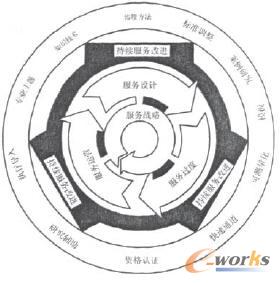
Figure 1 ITIL Service Lifecycle Framework
ITIL views IT services as having a service lifecycle, much like a project. Service Strategy is the axis of the entire service lifecycle management. ITIL recommends first formulating a service strategy, then proceeding to service design and transition, and finally to service operation.
Formulating a service strategy primarily involves several key activities: defining the market, developing offerings, developing strategic assets, and preparing for execution. Just as one must consider all possible factors during project planning, developing a service strategy requires striving to answer questions such as: What services are provided to whom? How to differentiate from competitors? How to classify services reasonably and visualize their value? How to define service quality? How to effectively allocate resources through a service portfolio? The reasonable classification of services into a service catalog also helps visualize value. Service management achieves the content of the service catalog through the adjustment of capabilities and resources. ITIL considers service management to be a form of strategic capital, as shown in Figure 2.
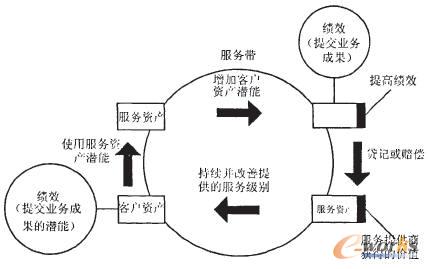
Figure 2 Developing Strategic Assets
3.2 ITIL Service Operation
Service Operation delivers manageable services that meet agreed service level agreements to customers by executing a series of activities and processes. ITIL classifies common occurrences in service operation into events, incidents, requests, and problems. A very important role in Service Operation is the Service Desk. For users, the Service Desk is their single point of contact with the IT department, ensuring they can find the relevant technical personnel to resolve their issues and requests. Sometimes the Service Desk is called a Help Desk. However, in ITIL, the main task of the Help Desk is to record, resolve, and monitor issues arising during IT service operation, mainly associated with incident management. The Service Desk has a broader scope. The Service Desk is not only responsible for handling incidents, problems, and customer inquiries, but can also provide an interface for other activities and processes, as shown in Figure 3.
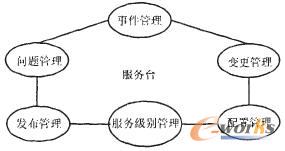
Figure 3 Main Service Desk Process
Service Desks typically fall into three categories: Distributed Service Desk, Centralized Service Desk, and Virtual Service Desk.
The Distributed Service Desk model: Each region or branch has its own service desk to support its respective business operations. The Centralized Service Desk is a physical service center that handles all service requests centrally. The Virtual Service Desk refers to a special type of distributed service desk model that uses virtual interfaces and automatic call distribution technology to achieve unified global or regional service communication, thereby maintaining a single point of contact with users. A Virtual Service Desk can transcend time and location constraints, arranging technical personnel to provide on-site service as needed.
4 Specific Implementation of ITIL Management
4.1 Specific Implementation in Overall IT Service Management
IT outsourcing is no longer a new term. For IT service providers, how to deliver good IT service is undoubtedly the key to survival. In the past, companies focused more on how many projects they could secure, with less overall consideration given to project evaluation. After applying ITIL concepts, companies gradually started using corresponding thinking patterns to consider the entire service strategy. After analysis, it is believed that companies should target well-established domestic and foreign-funded enterprises, as well as government agencies, especially those willing to accept formal IT service management. If competing with local companies, foreign-funded enterprises find it difficult to gain an advantage on price. Companies must rely on their past performance and reputation in providing IT support for major international and domestic sporting events, striving to create a brand effect to differentiate themselves from competitors. In terms of services offered, aim to win good profit returns with high-quality IT services. Projects with limited profit margins and low entry barriers will generally be avoided. Projects with limited profit margins and high risks will not be accepted. However, projects with high risks but beneficial to the company’s future business expansion will be considered on a case-by-case basis. In terms of improving service quality, ITIL theory will be promoted company-wide to elevate overall service awareness to a higher level. In terms of resource allocation, resources will be tilted towards projects with higher profit margins, while also paying attention to directions with future development potential.
4.2 Specific Implementation of ITIL in IT Service Operation
Service Operation is key to achieving customer satisfaction. During the service operation process, the service team faces various requests from numerous users every day. The quality of problem resolution and customer satisfaction directly impacts the fulfillment of service agreements. Based on ITIL, the company designed an operational model called CSDM (Continuous Service Delivery Model) that meets the organization’s corresponding quality standards, as shown in Figure 4.
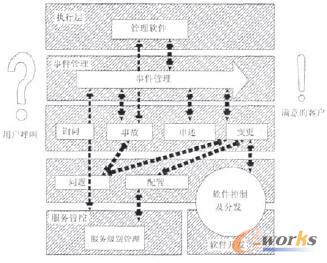
Figure 4 CSDM Architecture
Event management within this model involves monitoring all events occurring in the IT infrastructure to ensure the normal operation of the IT system. Event management is also responsible for detecting exceptions and performing necessary escalations. Effective service operation requires timely control over the operational status of IT facilities and identification of any deviations from service standards, which depends on an effective monitoring system.
For example, a global company producing automotive parts required management of its Asia-Pacific network and servers, as well as service desk support. After negotiation, a shared centralized data center and service desk were adopted for remote management and support. The data center used WHATSUP to monitor 7×24×365 network connectivity and server performance for servers within its scope. The service desk adopted a multi-level technical support model. This allowed system management and service desk personnel to handle service events from different clients simultaneously, ensuring both timely monitoring and cost control.
4.3 Specific Implementation of ITIL in Continual Service Improvement
As the saying goes, good, better, best. Never let it rest. Service improvement is essential for IT suppliers, both for the service projects offered and for their own service design. From a customer-facing perspective, more service improvements are targeted at improving the service processes and service quality provided.
The PDCA method is applied to improve service quality. First, the service team recognizes that the handling of service events needs measurement. Then it clarifies that the number of service events, the response time to events, the time from event opening to closure, the number of problems, and the number of requests are all measurable. The service team uses a dedicated event management system to record all events. Through this software, the service team collects data according to established goals and existing event classification principles, then analyzes it to determine service gaps, trends, and the impact of services on the business. Subsequently, based on internal and external requirements, the direction and content of service improvement are determined.
5 Experience from ITIL Practice
ITIL is the service blueprint for ITSM (IT Service Management), but its practical application is a gradual process and must be integrated with the organization’s culture and environment. ITIL theory covers a wide range of aspects, and attempting to complete improvements in every aspect overnight is simply a fantasy. Implementing ITIL through a strategy of achieving partial success first, then expanding to a comprehensive victory is more feasible. Here, using the aforementioned IT service provider as an example, some experiences are briefly described.
Initially, the service terms in the IT service contract were described rather roughly, containing some subtext considered industry practice, with many gray areas. As a result, many disputes arose with the client company during service operation. The gap between the client’s understanding and the provider’s concept led to significant communication costs and manpower expenses, also causing customer dissatisfaction. The account manager had to spend a lot of time on this client