

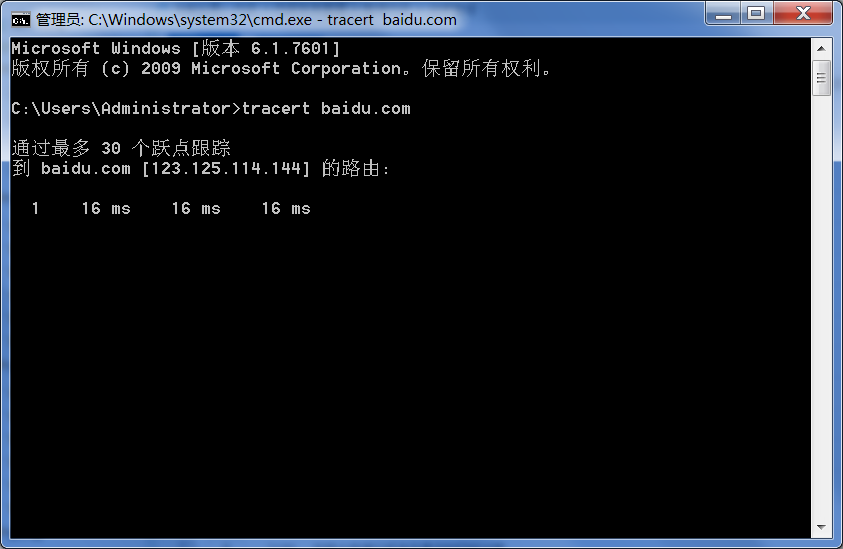
Tracert (Trace Route) is a route-tracing utility used to determine the path taken by an IP datagram to reach its destination. The Tracert command uses the IP Time-To-Live (TTL) field and ICMP error messages to determine the route from one host to other hosts on a network.
By sending “Internet Control Message Protocol (ICMP)” echo packets with varying IP Time-To-Live (TTL) values to the destination, the Tracert diagnostic utility determines the route taken to the target. Each router along the path is required to decrement the TTL on a packet by at least 1 before forwarding it. When the TTL on a packet reaches 0, the router should send an “ICMP Time Exceeded” message back to the source system.
Tracert determines the route by first sending an echo packet with a TTL of 1, and incrementing the TTL by 1 on each subsequent transmission until the target responds or the maximum TTL is reached. The route is determined by examining the “ICMP Time Exceeded” messages sent back by intermediate routers. Some routers silently discard packets with expired TTL values, and these will not be visible in the Tracert utility.
The Tracert command supports several options, as shown below.
tracert [-d] [-h maximum_hops] [-j host-list] [-w timeout] target_name -d銆€–銆€Specifies that IP addresses should not be resolved to host names. -h maximum_hops銆€–銆€Specifies the maximum number of hops to trace the route to the host called target_name. -j host-list銆€–銆€Specifies a list of router interfaces along the path taken by the Tracert utility packets. -w timeout銆€–銆€Waits for the specified number of milliseconds for each reply timeout. target_name