

Recently, a post about “using a soda can to boost Wi-Fi signals” went viral on Weibo. The post detailed the steps and principles, explaining that the inner surface of an aluminum can reflects radio waves, strengthening the antenna’s ability to transmit and receive signals. A router antenna originally emits waves in a 360-degree pattern. By attaching a soda can, the electromagnetic waves are concentrated into a 180-degree arc, thus enhancing the Wi-Fi signal.
As soon as the news broke, it sparked a wave of “DIY can signal booster enthusiasm.” Many netizens followed the Weibo guide, crafted their own Wi-Fi signal boosters, and proclaimed, “It really works!” However, experts have raised doubts. Slipping a modified soda can onto a router does not increase the router’s power; it only boosts the signal on the concave side of the can. The can focuses the wireless signal forward, causing the radio waves behind it to weaken. This would result in a worse signal behind the router. So, can a soda can really boost a Wi-Fi signal?
Can a soda can really be instantly transformed into a wireless signal amplifier? To get to the bottom of this, a CCTV.com reporter conducted an experiment in a residential community near Yuyuantan Park in Beijing. The equipment used included: one aluminum can, a utility knife, a pair of scissors, a wireless router, and a laptop.

Following the steps provided online, the CCTV.com reporter first made a “Soda Can Wi-Fi Signal Booster.” First, the reporter selected an aluminum can, rinsed it clean, and removed the pull tab. Second, using a utility knife, the entire bottom of the can was cut off (aluminum sheeting is very sharp and can easily cut hands, so caution is required). Third, a portion of the can was cut open, leaving about 1cm uncut near the drinking opening. Fourth, a vertical line was drawn on the side directly opposite the uncut part, and the can body was cut into two halves along this line. Finally, the can body was spread out into a fan shape, placed upside down, and the router antenna was inserted through the drinking opening. If the router antenna is taller than the can body, it is better to make a second one and fit it over the outside of the first.

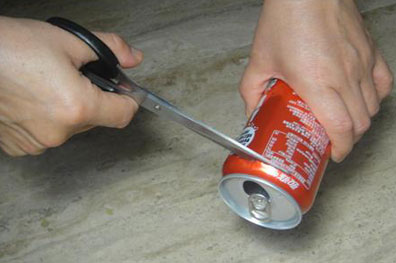
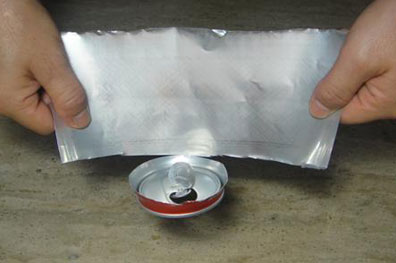
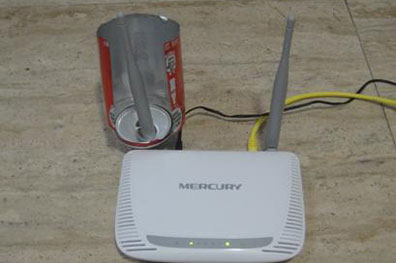
With preparations complete, the reporter began the first test. First, we used the laptop to test the effectiveness of the soda can Wi-Fi booster. Standing in a room roughly 10 meters away from the router, the laptop displayed a signal strength of three bars before the homemade booster was attached.

After the reporter attached the homemade device, the laptop's signal indicator showed full bars.

The experiment revealed that when the laptop was placed in the same position, the signal strength before using the device was noticeably weaker than with the soda can attached. Therefore, the homemade can signal booster can amplify the wireless signal.
Afterwards, the reporter conducted a second experiment to test how the orientation of the homemade device affects the signal. We found that when the concave side of the can device faced outward and the laptop was directly in front of it, the laptop displayed a full signal. When the laptop was placed behind the concave side of the device, the signal displayed on the laptop underwent a drastic change, fluctuating from full bars to three bars, and then to no signal at all.
Signal Becomes Focused, but Power Remains Unchanged
After the experimental proof, the CCTV.com reporter interviewed Professor Wu Guiqing from the College of Electrical and Information Engineering at Hunan University. He stated that attaching a soda can to a wireless router's antenna essentially becomes a question of antenna efficiency. Antennas are used to receive and transmit signals, and their transmission and reception can be calculated theoretically. This simple device actually operates on the same principle as the satellite dishes we commonly see. The can placed on the antenna effectively functions like the dish of a satellite antenna. The satellite transmits signals via the dish, absorbs external electromagnetic waves, and then reflects them to a focal point, thus concentrating the electromagnetic waves. “I have not done this specific experiment, but I think it is very likely to improve the antenna's efficiency,” Wu Guiqing said.
Signal amplification is plausible, according to Yang Changxi from the Optoelectronics Research Institute at Tsinghua University. Antennas inherently can amplify signals, making electromagnetic waves stronger. Placing a soda can on an antenna is equivalent to increasing the antenna's length and thickness, thereby boosting the signal. There is also a certain resonance principle at play, and this resonance can also enhance the signal. This simple device cannot increase the wireless router's power, because increasing power requires energy and must comply with the law of conservation of energy.
Any metal with emissive properties can enhance a signal. However, homemade signal boosters have a fatal drawback. Professor Wu Guiqing noted that such homemade devices do not amplify the signal in all positions; if placed incorrectly, they can actually weaken the signal.
Off-the-Shelf Signal Boosters Are More Convenient
Professor Wu Guiqing told the reporter that this phenomenon occurs because homemade boosters can only focus the signal and cannot change the working efficiency of the wireless router. Moreover, current wireless routers on the market use extremely high two-by-two stimulus frequencies. This makes the shape you cut the can into and its placement critically important, requiring repeated experimentation for verification. Wu Guiqing said that commercially available wireless signal boosters truly amplify the router's power, whereas our homemade version only amplifies the antenna's efficiency. It is similar to the principle of audio amplifiers we buy, which make sound louder by adding energy through a power source.
Subsequently, the reporter visited a Dazhong Electronics store near Beijing's Central Radio & TV Tower. According to staff, wireless signal boosters generally range in price from 100 to 500 yuan, and they sell even better than wireless routers. “They are compact, convenient, and multifunctional; some can even function as wireless routers.